 Zurück zur Hauptseite / Back to main page
|
Zurück zur Hauptseite / Back to main page
|
This seminar applies the fundamentals of distributed systems and cloud computing in practice. Groups of students combine various hardware and software components into a complex system to enable the practical application of artificial intelligence.
The goal of the semester project is to develop an edge computing monitoring solution to identify people and detect threats. Each group of students will develop, build, test, document, and present a complex hardware and software system that automatically detects people and identifies threat situations or events such as theft, fire, or vandalism. The semester project includes these tasks:
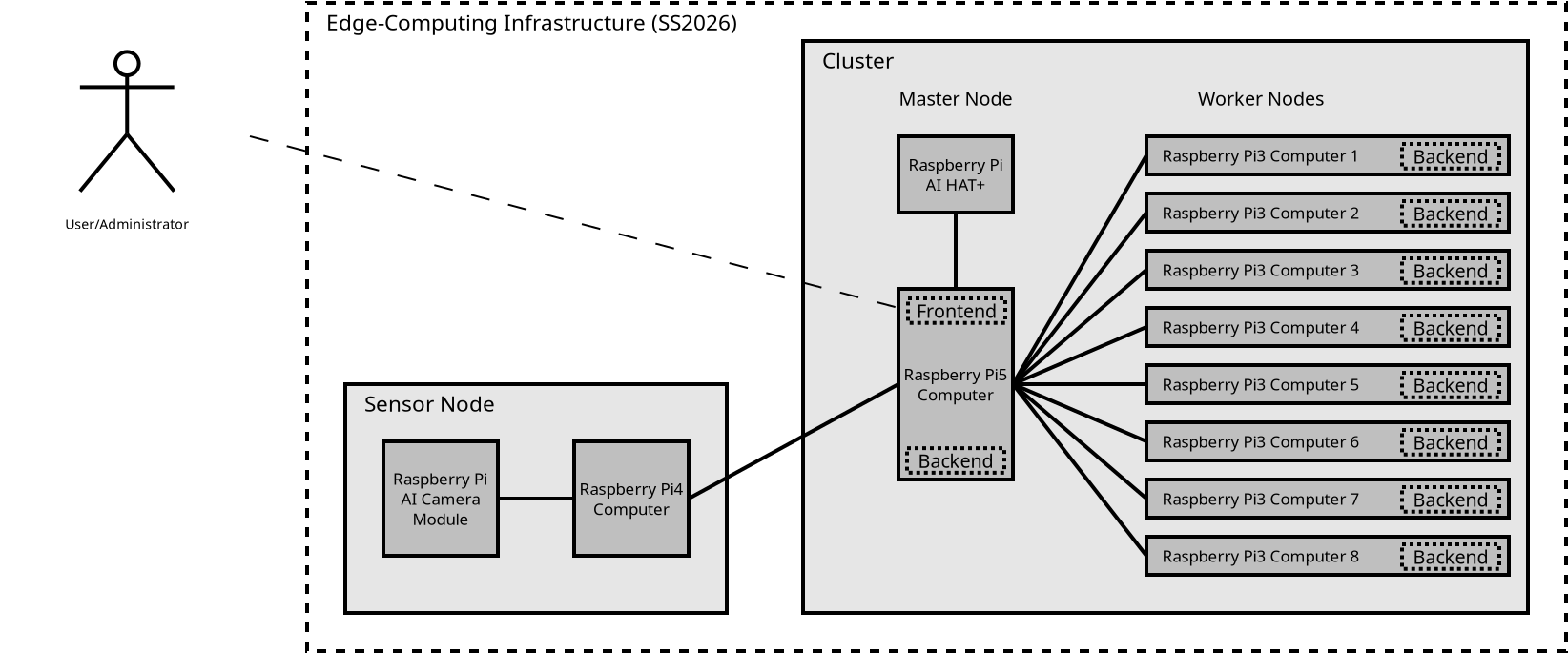
This course has no written exam. Instead, your individual grade will depend entirely on your work and the results of the semester project.
| Date | Time | Room | Target Audience | Topics |
|---|---|---|---|---|
| 16.04.2026 | 10:00-13:00 | 1-234 |  (Allgemeine Informatik) (Allgemeine Informatik) |
Einführungsveranstaltung, Gruppenfindung, Anforderungsanalyse, Projektplanung |
| 16.04.2026 | 14:15-17:15 | 1-234 |  (High-Integrity Systems) (High-Integrity Systems) |
Semester project introduction, team building, requirements analysis, task identification, time planning |
| 23.04.2026 | 10:00-13:00 | 1-234 | (Allgemeine Informatik) |
Gruppenarbeit |
| 23.04.2026 | 14:15-17:15 | 1-234 | (High-Integrity Systems) |
Teamwork |
| 30.04.2026 | 10:00-13:00 | 1-234 | (Allgemeine Informatik) |
Gruppenarbeit |
| 30.04.2026 | 14:15-17:15 | 1-234 | (High-Integrity Systems) |
Teamwork |
| 07.05.2026 | 10:00-13:00 | 1-234 | (Allgemeine Informatik) |
Gruppenarbeit |
| 07.05.2026 | 14:15-17:15 | 1-234 | (High-Integrity Systems) |
Teamwork |
| 14.05.2026 | ----- | ----- | ----- | Christi Himmelfahrt, Feiertag |
| 14.05.2026 | ----- | ----- | ----- | Ascension Day, public holiday |
| 21.05.2026 | 10:00-13:00 | 1-234 | (Allgemeine Informatik) |
Gruppenarbeit |
| 21.05.2026 | 14:15-17:15 | 1-234 | (High-Integrity Systems) |
Teamwork |
| 28.05.2026 | 10:00-13:00 | 1-234 | (Allgemeine Informatik) |
Gruppenarbeit |
| 28.05.2026 | 14:15-17:15 | 1-234 | (High-Integrity Systems) |
Teamwork |
| 04.06.2026 | ----- | ----- | ----- | Fronleichnam, Feiertag |
| 04.06.2026 | ----- | ----- | ----- | Corpus Christi, public holiday |
| 11.06.2026 | 10:00-13:00 | 1-234 | (Allgemeine Informatik) |
Gruppenarbeit |
| 11.06.2026 | 14:15-17:15 | 1-234 | (High-Integrity Systems) |
Teamwork |
| 18.06.2026 | 10:00-13:00 | 1-234 | (Allgemeine Informatik) |
Gruppenarbeit |
| 18.06.2026 | 14:15-17:15 | 1-234 | (High-Integrity Systems) |
Teamwork |
| 25.06.2026 | ----- | ----- | (Allgemeine Informatik) |
Dienstreise |
| 25.06.2026 | ----- | ----- | (High-Integrity Systems) |
Business trip |
| 02.07.2026 | 10:00-13:00 | 1-234 | (Allgemeine Informatik) |
Gruppenarbeit |
| 02.07.2026 | 14:15-17:15 | 1-234 | (High-Integrity Systems) |
Teamwork |
| 09.07.2026 | 10:00-13:00 | 1-234 | (Allgemeine Informatik) |
Gruppenarbeit |
| 09.07.2026 | 14:15-17:15 | 1-234 | (High-Integrity Systems) |
Teamwork |
| 09.07.2026 | 16:00-17:00 | 1-234 | (High-Integrity Systems) |
Presentation Team 3 |
| 16.07.2026 | 12:00-13:00 | 1-234 | (High-Integrity Systems) |
Presentation Team 5 |
| 16.07.2026 | 14:15-15:15 | 1-234 | (High-Integrity Systems) |
Presentation Team 4 |
| 16.07.2026 | 15:15-16:15 | 1-234 | (High-Integrity Systems) |
Presentation Team 6 |
| 16.07.2026 | 16:15-17:15 | 1-234 | (High-Integrity Systems) |
Presentation Team 7 |
| 26.08.2026 | 13:30-14:45 | 1-237 | (Allgemeine Informatik) |
Präsentation Team 1 |
| 26.08.2026 | 14:45-16:00 | 1-237 | (Allgemeine Informatik) |
Präsentation Team 2 |
| 26.08.2026 | 16:00-17:17 | 1-237 | (High-Integrity Systems) |
Presentation Team 8 |
| Slide set 1 | Exercise sheet 1 | Solution | Organisational information, client server, fundamentals, laws and limitations, parallel computers |
| Slide set 2 | Exercise sheet 2 | Solution | Cluster Computing |
| Slide set 3 | --- | --- | Cloud Computing, services and concepts, opportunities and risks |
| Result of the evaluation (Allgemeine Informatik) |
| Result of the evaluation (High-Integrity Systems) |
The best way to reach me is by email: christianbaun@fb2.fra-uas.de
|
Prof. Dr. Christian Baun Frankfurt University of Applied Sciences (1971 to 2014: Fachhochschule Frankfurt am Main) Faculty of Computer Science and Engineering Last updated: August 25th, 2026 |